Pages

Showing posts with label language and science. Show all posts

Tuesday, December 4, 2012

Creating Concept Maps to Review for an end of unit test

We just finished our weather unit....we learned a lot about fronts, clouds, weather data, etc...It was time to test.  I don't know about you...but, how many jeopardy games can you play to review? Also...are you reviewing at a higher level or just basic recall?

I had learned this concept from FOSS last year and was looking for the perfect opportunity to use it in the classroom.

Building Concept Maps:  

First we got into our science groups.  I gave each group a pack of sticky notes and a piece of large chart paper.

Next, I asked them to brainstorm as many weather words as they could think of - they were allowed to use their notebooks and study guide as a resource (part of my thinking was to get them used to using resources to study).


After 5 minutes...I stopped and modeled how to create a concept map.  As you can see on the side, I took my sticky notes and put them on the chart while drawing arrows and connecting the words together. We talked about what words were similar or different.  We talked about cause and effect.  We even talked about compare and contrast!  This was turning out to be much higher level thinking during the review process!


Here are a few of the finished products.  We hung them in the hall for a week (until the sticky notes lost their stickiness and fell to the ground!)


Comment:

Saturday, November 24, 2012

Cross Curricular Language Arts Connections

Do you feel like you are running on a hamster wheel?  Do you feel like we are working harder and not smarter?  One of the ideas that I have grasped onto over the past few years is the idea of a "curriculum economy".  We have soooooo many things to teach and so little time.  We try to teach random discrete skills and it is overwhelming to us and confusing to the kids...right???

My FOSS representative, Kip Bisignano introduced me to the concept of infusing my language arts skills into my content area.  After all, our principal wants us to teach reading/language arts for 90 minutes or more at the detriment of our science or social studies instructional time. Guess what happened?  My reading scores went from mid 70% to 94% (three years in a row!).

I have created a new packet of activities that you can use to imbed language into your science class around the topic of weather.  I am charging for this one because it is 27 pages of stuff you can use!  (Besides it took me a long time to create it!)

As part of Cyber Monday, I am offering this packet (along with Kicking Off the Year with Mentos) for 20% off Sunday - Tuesday Nov. 25-27th.

Let me know what you think if you purchase it! I am working on creating more reading passages that correlate with science standards for the future!


Comment:

Tuesday, October 9, 2012

Language of scientific arguing....

Do you let your students "argue"????  Real scientists argue quite often...but not a drop down fight, more like a sharing of ideas.

One of my favorite books for introducing this concept is Why do Scientist Disagree? This book ties in nicely to my space unit because it is a tale of two stories.  On the left side is a story about Galileo and his argumentation with scientists about light from the moon and the other side is a modern story of scientists diagreeing.   

I try to set up these discussions based on misconceptions I hear in the classroom.  For example, I have heard "the moon causes day and night" quite often in my fourth grade class.  Rather than saying, no - that is not correct, I set up the situation with the kids and say...."What do you think? and Why do you think that?"

I set it up by introducing these question frames to guide the discussions:

  • What do you think?
  • What is your claim?
  • Why do you think that?
  • What is your evidence?
  • Do you agree? Why?
  • Do you disagree? Why?
  • How sure are we?
  • How could we be more sure?
Then it is important to also provide the sentence starter frames.

I think....
I claim....
My evidence is....
I agree with ....because
I disagree with ....because
I am sure....because
I think we could be more sure if we....

Of course, I needed to make them a little cuter too! 

To get your copy of these sentence frames on a sheet, click here.


Sunday, March 25, 2012

Connecting Science with Read Alouds....

Somehow I find the time to connect science into every part of my day....I guess it's my passion and it overflows into all areas!

Right now we are reading Owl in the Shower  by Jean Craighead George.  It is an excellent story about the fate of an owl after a logging company has clear cut the land in the Northwest.  It is told covering the points of view of the owl (sort of), the logger (Leon) and the tree huggers (the teacher! ha ha). My students and I are familiar with owls living in Virginia, but not with the controversy surrounding the spotted owl out west.  The book is full of great vocabulary, interesting points of view, funny owl stories and lots of true facts. We have loved every minute of it!

As I have been reading it, I started a vocabulary chart to post in the room.  I ask the kids to remember three interesting words from the day's read aloud that we may need to discuss and add to our wall.  We have also added picture of the barred owl (Bardy in the story) as well as the spotted owl.  This is a great visual for discussion as well!

Recently, I decided to have the students do a Quick write to share what they had learned about owls from the book. We were fortunate to have the ibooks visiting in our classroom for the day and so they pleaded with me to let them type the quick writes out. No argument here!

Here are a few samples.  I always find it interesting to see how each child personalizes their typing with fonts - some choose very linear and traditional fonts while others choose more "fun" fonts!


Saturday, March 17, 2012

Vocab Strategy - embed it in science!

My reading specialist just spoke with the staff about language development. My school is a typical suburban school where we have many economic ranges.  However, lately our lower economic level has increased.  With poverty, comes delays in language.  Traditional methods of teaching vocabulary doesn't work very well for most of those students.  What does work?  Embedding language into your content area. 

So when do you teach content vocabulary? Many teachers think they need to teach words before the encounter them.  But, research has shown that students really remember words better if they have the experience first and learn the words as they go.  Think about how toddlers learn words? As they go...when you see a bird, you say "Look at the bird."  You don't teach them bird without a bird nearby, that would be crazy.  So why do we do that in school?

Here are a few strategies that I feel are the most beneficial...

I know you have heard me say before how important I still feel word cards are in the upper grades.  Having a pocket chart with words you can pull out and carry around the room while you teach is a great strategy.  Another strategy that works is creating anchor charts with removable word cards to fill in like a cloze activity.


Of course, the most useful tool in any science classroom is using a science notebook.  In these notebooks, students can predict, plan, organize thoughts, reflect, draw diagrams and label words in a meaningful context.  As we learn we write and reflect with language...and at the end of a lesson, we may go back and highlight or circle specific content words that they need to know in different colors.  We add these words to our vocab charts and then use them in real world situations in our class....that's meaningful.  

Wednesday, March 7, 2012

Smart Board Review Game - Magnetism and Electricity

How do you review?  I am finishing up my unit on Magnetism and Electricity - yay!  The test is written and put in for copies.  Now, it's time to review.  How do I do it to meet the needs of all students?  This week I planned for two days of review. 

First, we did a review on the Smartboard.  I came up with 20 questions (with graphics) to review the main concepts.  Some of you may have fancy clickers.  I have fancy (ha ha) mini white boards that they can write their answers on and hold up for a quick assessment.


The next day, we made graffiti walls to showcase key words and concepts that they thought were important. This appeals to the students who are visual learners or the ones (like me) who have to write it down to remember.  Here are a few of the finished products. 


How do you review?


Sunday, February 26, 2012

Do you practice how to write up an investigation?

Practice...

I just finished watching my son play in a championship basketball game for his U9 team at the YMCA.  As I watched, I thought we never could have gotten here without the specific and targeted practices each week.  The coach watched each player and would have them practice what they needed.  Some may practice free throws, some layups, and some defense.  But put it all together, and we won many basketball games.  Not bad for a child who had never played before!

Now, why am I telling you this? So often I think we expect kids to perform to high expectations without the practice it takes to get there. 

In my classroom we have been working on building electromagnets and we were ready to move to the next step - designing your own investigation.  I wanted them to be able to think of the question, make a prediction, record their data and write a conclusion on their own.  But before we could do this, we needed to practice. 

I set up the practice session by telling them I wanted them to test how many washers it would take with a set number of winds of coil.  Each group needed to pick a number to test and write it as a question.  Next, we talked about how to write your prediction.  Then, we practiced writing a plan with a format that looked like this: Step one, Step two... I showed them how to record data and finally a conclusion step.


Here is an example of how one of my students wrote up his practice plan in his science notebook.


If you are interested in grabbing the format for the plan, you can click here for a freebie... You can run this off for students who need the structure, of you can use it yourself to help you plan how to format a science notebook page.  Check back in tomorrow to see how they did with their small group investigations ... on their own!

Friday, February 17, 2012

Questiong.....

When I was in graduate school at Lesley University (online program in science education rocks!) we spent a lot of time focussing on questioning.  These are some of my favorite question prompts that came from an article that we read within Wynne Harlen's book.  By the way, if you haven't read this book - I highly recommend it! 


I use these questions in all areas of my classroom.  They fit into math, reading, and social studies.  Just yesterday we had a great discussion about the revolutionary war based on a painting and questioning was the key to it all. 


Questioning Strategies from “The Right Question at the Right Time” by Jos Elstgeest  in Primary Science: Taking the Plunge by Wynne Harlen

1.  Attention Focusing questions: 

          'What is it?' 'What does it do?' 'What does it show about itself?'

          'What happens?'

'What do I find inside (outside)?' 'What do I see, feel, hear? Have you seen?  Do you notice?  What is it?

These are the simplest questions.


2.  Measuring and counting questions

Questions such as 'how many?', 'how long?' and 'how often?', are measuring and counting questions  the children can check their answers themselves.


3.  Comparison questions

          Other, more qualitative, comparison questions bring about sharper      observation. For instance: 'In how many ways are your seeds alike and how do they differ?'


4.   Action questions:

          These are 'what happens if' questions which can always be truthfully answered.  What happens if you place your ant lion in damp sand? What happens if you pinch the seed leaves off a young growing plant? What happens if you place a cutting or twig in water? What happens if you put your twig upside-down? What happens if you hold your magnet near a match? What happens if you throw a tiny piece of paper in a spider's web?


5.      Problem Posing Questions:

The 'can you find a way to' question comes in many guises. 'Can you make a mealworm turn around? 'Can you make a sinking object float?' 'Can you separate salt from water?' It is in essence a prediction question, a more complicated 'what happens if' question turned around. Finding the solution necessitates the forming of a simple hypothesis and consequent verification in a very direct manner.


You you enjoy these questions! 

Sunday, February 12, 2012

AYP...feeling the pressure???

As midyear assessments roll around, we have been talking a lot about math and reading.  Are we making growth? Yes!  Will they all pass the state assessment?  Hmmmm....In Virginia we are up to needed 90% of our students to pass the state assessments in math and reading in order to make AYP. 
My school just had our annual review of our School Improvement Team and we realized that we need more time for intervention groups.  Should we take time away from social studies and science to ensure that they are ready to pass the tests??? This is a BIG QUESTION on a lot of teacher's minds.  No one wants to do this...but let's face it, many are.

I want to share some knowledge that I have about why it is important NOT to take away science education.  Research at the Lawrence Hall of Science has shown an increase in reading scores for students using effective science programs - such as FOSS, Seeds of Science, or STC. 

But my own research shows the same results.  When I first came to fourth grade we were switching classrooms and everyone taught one unit four times.  I taught Earth, Sun and Moon.  My reading scores...were okay.  I had 80% meeting the benchmark.  At that time, the reading specialist and her team were pulling kids daily for 45 reading intervention.

The next year I said:  Stop the madness!  I taught my own class all the science units and used quality science curriculum along with science notebooks.  I asked the reading specialist to push in, rather than pull out.  I began to embed literacy strategies within my classroom - using vocab posters, pocket charts, anchor charts, science notebooks, reading non-fiction science books, oral presentation and reflection.  Guess what?  My reading scores soared.  For the next two years I had 96% passing rate of my students (not counting the children who were taught reading in the LD room - I did not teach them reading.) This year, I am expecting 100% to pass. 


So think about this when you are asked to give up something that you know is working.  Do your students light up when you pull out a light bulb and wires? (ha ha) Are they engaged and interested in school mainly due to projects going on in your science classroom?  Then DO NOT stop it...keep it up...the results are worth it...

Monday, January 30, 2012

Using Squirtle as a Hook for Writing....

 Squirtle the Turtle is longing for some stories....

  Last week I opened up to the students that for writing workshop I would like them to write about Squirtle.  It could be any form they chose:
     Poetry/Song
     Narrative (what they have seen)
     Adventure (make believe)
     Or any other topic so long as I approved it first.  The kids took this idea and  ran with it...

Some topics include:
  • Katie wrote a diary entry from Squirtle's point of view in which he decided to break out of his tank!
  • Lilly wrote about Squirtle's adventures at night...did you know he watches TV? He lovesToy Story.
  • Jordan wrote a tongue twister - Squirtle squats by the squirt shore.  Turtle twisted toward the tortoise shore.
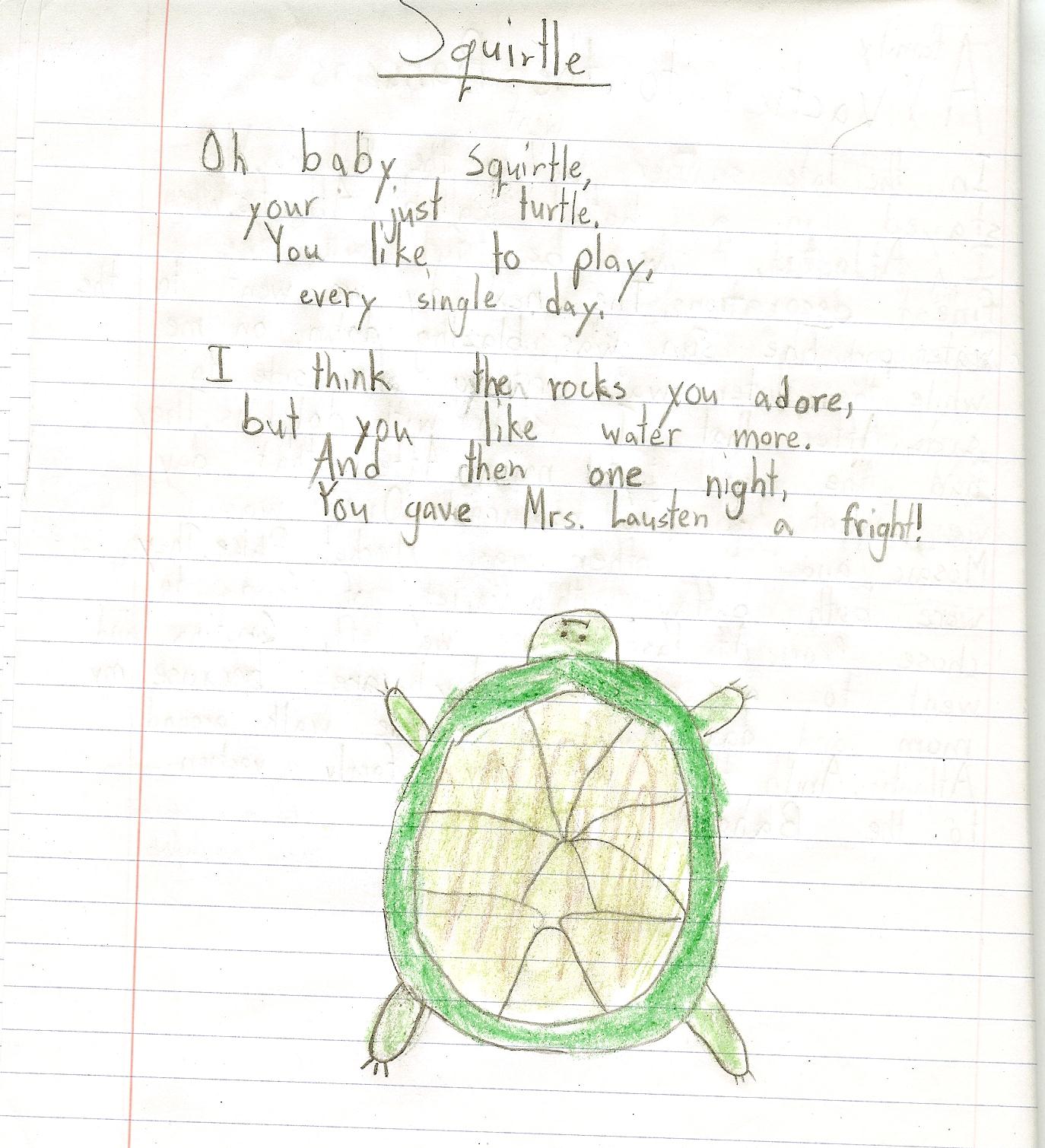
  • Amber and Tim wrote poems (as did my paraprofessional Tana)
  • Broderick wrote all about how the turtle pees on the floor (this really bother him!)
  • Darlene wrote about how we got him and how old he is...
  • Shane and Robert wrote what they have noticed about him - he came from Petsmart, he is shy, etc...
  • Kayla wrote about him secretly being Oprah!
  • Dean wrote a story about him being a Pharoah (he is currently reading the Red Pyramid series)
All of the topics were wonderful and fun to read...I'll leave you with a few to whet your appetite.   Apoem by Tamia...


And a Cartoon by Ben...


Monday, January 9, 2012

JigSaw

JigSaw Reading Strategy....

      I try to balance investigation with content knowledge in my classroom. Let's face it, sometimes you have to read a book to get the knowledge you need to connect to the investigation, right? But there are effective ways to use a text book and ineffective ways.  One of my favorite ways to use nonfiction text is by using the JigSaw method.

This is how it works: 

1.  First you need to read the text to make sure it covers what you want your students to know. 

2.  I picked these four sections -

Pushes and Pulls, Friction, Position & Motion, Acceleration

3.  Next, I prepare four chart papers with the title and the page numbers at the top of each.
Put one chart paper and one book at each table.  Give each group a different colored marker to use - group 1 red, group 2 blue, group 3 green, group 4 orange.

4. Finally, give the kids about 5 minutes at each table to read the section and record at least one important thing they learned.  Try not to repeat each other.  After 10 minutes, switch to the next poster and repeat the process.
 
5.  After every group has read and recorded the key ideas, have the final group share the poster they just completed.  Make sure they read all the ideas.