Pages

Showing posts with label Books I Recommend. Show all posts

Friday, August 24, 2012

Children's literature that connects to science...

In keeping with thinking about the start of the year, I thought I'd post a few of my favorite science books as well.

Here are a few of my favorite books to start off the year -

  • Monday with a Mad Genius by Mary Pope Osburn is a Jack and Annie tale where they travel back in time to meet Leonardo Da Vinci. That in itself is a cool idea - but what makes this book special is that they follow him throughout his day and see his ups and downs. The book shows that even Leonardo made mistakes and yet he kept on investigating and learning. The book also talks about combining drawing with science and even talks about his SCIENCE NOTEBOOKS. It is a wonderful story and a great start to the year.

  • Boy Were We Wrong About Dinosaurs: This is another great book for the start of the year because it talks about how scientists have changed their thinking over the years. It talks about theories that were once univerally accepted that are no longer true! Great book!


  • I love just about any book from Seeds of Science Roots of Reading...but my favorite is definately Why Do Scientists Diagree? I love this book on so many levels - first, it shows scientists in all forms - old, young, women, men, African American, Indian, Caucasian, Hispanic and Asian...second, it talks about how scientists must talk through their ideas together. Sometimes they disagree and sometimes they even get mad. I also love this books because it is a story within a story - on one side it shows the historical conflict between Galileo and his colleagues and on the other side it shows modern scientists disagreeing.
Another great Seeds book is Drinking Cleopatra's Tears. This book explains the Water Cycle in a question and answer format that is fun to read and informative too. It is also a little gross - like the part where we may be drinking a dinosaur's sweat. Kids love it!


Oh I could go on and on with this post...but will stop for now. I like the idea of showcasing books used in a unit. Our next unit is on Ecosystems: Plants and Animal Adaptations. If you would like, I can try to highlight the books we are using in class.

Monday, July 23, 2012

Raccoons

When I was a little girl, I loved raccoons.  They seemed so cute and cuddly!  As an adult, I know now that they are quite the opposite - they are actually pretty pesky!  They often get into trash in suburban neighborhoods and carry many diseases. 

As a science teacher, I try to compile activities that are science in nature...not artsy!  I hope these suggestions will help you in your classroom.

Websites: 

    National Geographic Kids has a great website with a video clip, map showing locations and printable fact cards for kids who love to to collect cards.

    Animal Tracking this PDF is a great idea for a science center where you can have students guess which footprint matches which animal.


Raccoon Diagram from Enchanted Learning.  This site has a lot of information, coloring diagrams and crafty ideas.


Children's Literature:


Product Details

Exploring the World Of Raccoons by Tracy C. Read

Product Details

Raccoon on His Own by Jim Arnosky
Raccoon Moon (Accelerated Reader Program series)


Thursday, June 28, 2012

Amazing Science Discovery

     Today I am recommending another resource that you might want to suggest to parents of your students. This resource was designed to help our parents help our students at home.  I think it would be especially good if you have school wide science fairs. 


It helps parents understand exactly what their children will be studying in each grade level.
It teaches parents how to develop in their children an interest and involvement in science depending on the grade level.
It explains, in plain English, specific topics that children will be tackling depending on their grade level.
It gives easy and fun experiments that parents and children can do together and learn from.
And, it helps create a special bond between child and parent by bringing them together through fun scientific activities!


It helps parents understand exactly what their children will be studying in each grade level.
It teaches parents how to develop in their children an interest and involvement in science depending on the grade level.
It explains, in plain English, specific topics that children will be tackling depending on their grade level.
It gives easy and fun experiments that parents and children can do together and learn from.
And, it helps create a special bond between child and parent by bringing them together through fun scientific activities!


To find out more about it, click on this link:  Amazing Science Discovery

Wednesday, June 27, 2012

Recommended Resource

I don't know about you...but I am always looking for a GREAT resource. I have found it! Laura Candler's new book Graphic Organizers for Reading. This books is amazing! Even though this is mainly a science blog, I wanted to share this book with you as a GREAT resource for reading across the content area.


Here are a few of my favorite parts of the book:

Graphic Organizers for Reading Book CoverFirst - Most graphic organizer books just give you the worksheets. Not this one...she explains HOW to use them using the "I do....We do...You do..." teaching method. She explains how to model correct usuage of the worksheet with sample lessons - all aligned to the Common Core standards for grades 2-6.

Another feature that I LOVE is that the graphic organizers are divided into two main sections: Multi-purpose and Information Text & Literature.

Wth the Multi-Purpose section she includes HOW to teach kids to choose the BEST graphic organizer, ways to introduce them in "FUN" catchy ways, sample lessons and sample sheets to see how kids might fill them in. These organizers can be used for more than just reading...these are great for SCIENCE too! They are full of T-charts, multi-column charts, Venn diagrams and more.

In the Informational Text and Literature section she suggests texts that would work well with the organizer, gives step-by-step techniques for teaching as well as the targeted reading strategies. We all need to DO science, but we also need to READ about science.  The Informational text is perfect for connecting reading skills to content area books - both trade books and text.

Finally...(I saved the best for last) are Laura's Tips. One of the reasons I love all of Laura Candler's products is because they are VERY TEACHER FRIENDLY. You can tell she is not just a researcher, but one who works with kids. Her tips are always spot on and just what you need to get you through a lesson.

The price is reasonable (under $25) and well worth it. There are enough graphic organizers to keep you busy all year! To learn more about it I recommend you go to this website to see more.

Monday, June 18, 2012

School is over....for now

We had our last day of school on Friday....it was bittersweet as always.  I had a AMAZING group of students who loved to learn, a terrific group of parents who helped them learn and a fantastic group of team members who I truly love working with.  My wonderful principal is retiring...another sad moment.  She has created a school where the students come first, the teachers like each other (shocker!) and have become a professional learning community, and hard work is actually appreciated.  As we wait for the new leader to be announced, I consider myself blessed to have worked for Cathy Walker for 22 years.  I hope the next 10 or so years will be as wonderful as the first 22!  We will see...

So what are my plans this summer????

I am contemplating writing a book...I am definitely reading some professional books..and I plan to play a bit, too. One of the books that I plan to blog about (it seems like everyone is doing a book study this summer) is  Writing in Science in Action by Betsy Rupp Fulwiler. I highly recommend this book if you are looking for a way to spruce up your science instruction.

Another one of my focuses for the summer will be to create some more lessons to place here on the blog to improve science education in your classrooms.  I am hoping to create a few in depth units for purchase as well as my usual freebies.  As always, they will be student centered and science notebook based.

On another note...when we started cleaning the room on Friday...guess who we found??? yes, Squirtle the Turtle!  He was hiding behind my desk...curled up in the computer cords.  (Very nicely camouflaged if I do say so myself!)

For now...I am taking a break while I clean out my classroom...See you soon!


Thursday, February 23, 2012

Thomas Edison

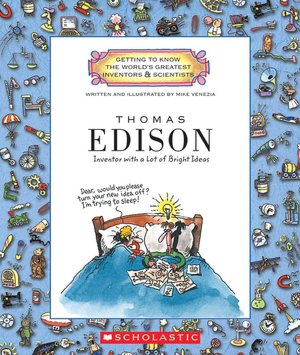
Thomas Edison: Inventor with a Lot of Bright IdeasThomas Edison is another famous scientist that we teach about in Fourth Grade.  I like him, too...for different reasons than Ben Franklin. For one, did you know he was probably either ADHD or on the Autism Spectrum? He also had a hearing disabililty. He did not speak until age 4 and was not liked by his teachers.  Why?  All he wanted to do was ask questions and take things apart!  He would fit in nicely with today's children. 
Luckily, Thomas Edison had good parents who supported him at home.  They helped him get plenty of books to read and he was allowed to take things apart. When I teach about him, I make sure that I mention his less than perfect start.  All kids need to see role models, and he has some great qualities to introduce to our kids.
The other thing I like about him is his spirit of invention! 


I usually use a picture book to introduce Thomas Edison. However, this year I am using a new source that I love!  Delta Education sells this graphic novel for the computer for $17.95.   I can't wait to project it on the big screen with my projector cart and engage my students as it reads aloud and highlights text for the students to follow! 

 I have provided a FREE worksheet that allows you to note his contribution (the light bulb) as well as his story of overcoming obstacles.  There is a spot at the bottom to brainstorm a quick write about your own possible invention. Click on the worksheet to grab for free!

Tuesday, February 21, 2012

Famous Scientists - Ben Franklin

How do you teach about Famous Scientists?  In Virginia we are asked to teach the students about the contributions of Ben Franklin, Thomas Edison and Michael Faraday as it relates to electricity.


I will start today with Ben Franklin...he is my favorite afterall!

Resources to hook the students:

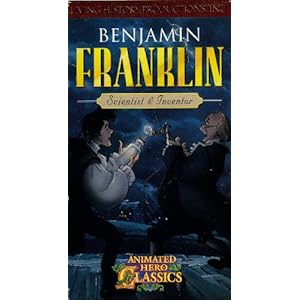
Favorite Video:  Animated History - story of Benjamin Franklin


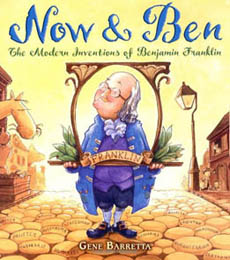
Favorite Books:  I love to connect children's literature to my science lessons.  Now and Ben is all about how the inventions of Ben Franklin have been modernized and are used today.

Some of my other favorites include the National Geographic version (full of beautiful illustrations), the Step into Reading one (is really about a math puzzle he created) and Ben and Me is just a sweet novel told from his pet mouse's point of view.


So besides these hooks that I use at other times in my day...what do I do? Our standards require that we teach students that Ben Franklin made a major contribution to science by creating the lightening rod.  Did you know that lightening is really static electricity?  So in keeping with my philosophy using inquiry as a basis for my lesson....we use this worksheet to fill in the main points for both his role in the Revolutionary War and in Science. 

You are welcome to grab this freebie! I am still working on how to insert a picture and link it to the docucment page.  Until I figure it out, here's the link at the bottom.


Friday, February 17, 2012

Questiong.....

When I was in graduate school at Lesley University (online program in science education rocks!) we spent a lot of time focussing on questioning.  These are some of my favorite question prompts that came from an article that we read within Wynne Harlen's book.  By the way, if you haven't read this book - I highly recommend it! 


I use these questions in all areas of my classroom.  They fit into math, reading, and social studies.  Just yesterday we had a great discussion about the revolutionary war based on a painting and questioning was the key to it all. 


Questioning Strategies from “The Right Question at the Right Time” by Jos Elstgeest  in Primary Science: Taking the Plunge by Wynne Harlen

1.  Attention Focusing questions: 

          'What is it?' 'What does it do?' 'What does it show about itself?'

          'What happens?'

'What do I find inside (outside)?' 'What do I see, feel, hear? Have you seen?  Do you notice?  What is it?

These are the simplest questions.


2.  Measuring and counting questions

Questions such as 'how many?', 'how long?' and 'how often?', are measuring and counting questions  the children can check their answers themselves.


3.  Comparison questions

          Other, more qualitative, comparison questions bring about sharper      observation. For instance: 'In how many ways are your seeds alike and how do they differ?'


4.   Action questions:

          These are 'what happens if' questions which can always be truthfully answered.  What happens if you place your ant lion in damp sand? What happens if you pinch the seed leaves off a young growing plant? What happens if you place a cutting or twig in water? What happens if you put your twig upside-down? What happens if you hold your magnet near a match? What happens if you throw a tiny piece of paper in a spider's web?


5.      Problem Posing Questions:

The 'can you find a way to' question comes in many guises. 'Can you make a mealworm turn around? 'Can you make a sinking object float?' 'Can you separate salt from water?' It is in essence a prediction question, a more complicated 'what happens if' question turned around. Finding the solution necessitates the forming of a simple hypothesis and consequent verification in a very direct manner.


You you enjoy these questions! 

Tuesday, January 3, 2012

How to introduce Force and Motion?


Today we are starting a new unit on Force and Motion.  I start by having them turn in their science notebook page to the next clean page and write a title page – Force and Motion.  Then they need to go to the table of contents to place what number this new unit starts on. 

            What do you know about Force and Motion? I believe one of the best ways of knowing what kids are actually thinking is to ask them what they already know (or think they know).
 I will Pass out 12 X 18 paper  to each table (four sheets total) and have the kids brainstorm what they know about force and motion.  They will work on this for about 15 minutes and then have each group share out what they know.
            What am I looking for?  I am looking to see if students remember that a force is either a push or a pull, simple machines can make the work easier, that motion is a change in position of an object with respect to time and acurate examples of force and motion in their lives.
            What else am I looking for?  I am looking for misconceptions, misunderstandings and ideas that need to be corrected before we can go further. 

            For last 10 minutes, have the kids draw pictures around the title in their notebook to show ideas about force and motion.

* I wish I had samples to show, but am home on surgery leave still so have no access to student work.  Only a few more days at home....yay.

Monday, January 2, 2012

Force and Motion

How do you start in fourth grade to introduce force and motion? Here in Virginia they have been exposed to this concept in k-1 learning about pushes and pulls related to toys, then in 2 expanding to pushes/pulls as related to magnets, and then in 3rd grade related to simple machines.  Where do we go from there?

Here are our State Required Standards:
SOL Standard 4.2

The student will investigate and understand characteristics and interaction of moving objects. Key concepts include

a)      motion is described by an object’s direction and speed;

b)      forces cause changes in motion;

c)      friction is a force that opposes motion; and

d)     moving objects have kinetic energy.


So...how do I break it down..so that it is interesting and meaningful to my students?


Part One:  Force/Motion with Roller coasters:

·         describe the position of an object (by location to another object or background)

·         collect and display data in a table and line graph to show time and position data for a moving object

·         explain that speed is a measure of motion

·         interpret data to determine if the speed of an object is increasing, decreasing, or remaining the same

·         identify the forces that cause an object’s motion

·         describe the direction of an object’s motion: up, down, forward, backward

·         infer that objects have kinetic energy

                        Part Two:  Mass and Friction with Cars

·         design an investigation to test:  “If the mass of an object increases, then the force needed to move it will increase.”

·         design an investigation to determine the effect of friction on moving objects:  write a hypothesis, identify dependent variable; independent variable, and constants.  Conduct a fair test, collect and record the data, analyze the data and report the results of the data

What do we need for part one?  Roller coaster tubes - I got this idea from More Picture Perfect Science Lessons.  They have a great lesson in there that I use as the "hook" for my unit.

Go to the local Lowes or Home Depot and buy some hose insulation tubing.  They are super cheap...I think I spent $10 total and had enough for the class. 

They look like this:

Then you will cut them in half - so that they are the same length but have an opening on top.

   The only other materials you will need are marbles, cups, tape and maybe some toilet paper tubes for tunnels.  More information to come...

Sunday, November 27, 2011

Have you seen????

Stranger in the Woods book coverI just love the website http://www.wiseowlfactory.com/ .  The author, Carolyn Wilhelmn has a goal to publish activities for a book a day for a whole year.  Recently, I came across one for the Photographic Fantasy Stranger in the Woods.   This is a book my mother in law gave me many years ago when I was first starting out in teaching and have used for many years since! 

She has published a great resource involving Inferring Questions based on the book and I would love for you to check it out. 

http://www.wiseowlfactory.com/BookaDay/PDFs/2011/11/ainferringwithstrangerinwoodsa.pdf


She has many other science related literature connections such as....

Agate, What Good is a Moose?
Animals Asleep
Stranger in the Woods picture of PDFAre You a Grasshopper?
Aunt Chip and the Great Triple Creek Dam Affair
Baby Whale's Journey
BATS by Gail Gibbons
Beaver at Long Pond
Biggest, Strongest, Fastest
Bonny's Big Day
CATS by Gibbons
Chameleon, Chameleon
Do Tornadoes Really Twist?
Earthquake in the Early Morning
Everybody Needs a Rock
FROG OR TOAD Nonfiction
Frogs, Toads, and Turtles
Fun Facts About Pets
GATHERING A Northwoods Counting Book
Hawk, I’m Your Brother
Honk, Honk, Goose
Hummingbirds ZOOBOOK
Hurricanes
I See a Kookaburra! Discovering Animal Habitats Around the World
Knut How One Little Polar Bear Captivated the World
Long Night Moon
Lost In The Woods: A Photographic Fantasy
Make Way For Ducklings
My Visit to the Aquarium
Night in the Country
On the Way to the Beach
OWL MOON by Jane Yolen
OWLS by Gail Gibbons
Rock Picker’s Guide to Lake Superior’s North Shore
Science Experiments & Amusements for Children
Spiders
STELLALUNA
SUN
The Emperor's Egg
The Night of the Fireflies
The Pumpkin Book
The Sea House
The Vegetables We Eat
There is a Tree
Tracks in the Wild
Trees, Leaves, and Bark
Volcanoes and Earthquakes
Wait Till the Moon is Full
Waterdance
WETLANDS A Survival Story
White Owl, Barn Owl
WIND

Hope you enjoy her website!