Pages

Showing posts with label STEM. Show all posts

Tuesday, July 8, 2014

Summer fun with Camp Invention

Have you ever heard of Camp Invention?  This is one of the ways I have spent my summer vacation!

Camp Invention is the only nationally recognized, non-profit elementary enrichment program backed by the National Inventors Hall of Fame. 


I had the opportunity to be the director of this year's camp.  It was our first time having the camp and the kids had a blast!  My principal's own children had attended this camp at another location one summer and he was very excited to introduce the staff to this STEAM related camp.  From a director's standpoint, I will tell you that the company provides ALL of the curriculum, material, training and support.  On my end, I helped to find the kids and take care of problems during the week.

Here is a great video clip from the camp that showcases more information about the camp's activities and the connection to real inventors.  


Here are some pictures of the kids and the products they invented.  Enjoy!

Using fabric to create and design fashion.

Taking apart electronics!  The kids loved this...who wouldn't? They then used pieces from the inside on a pinball machine that they created.

Can you hear inside the room?

Cooperation...collaboration...communication...

Look at the hat I engineered for Crazy hat day!


Prototypes for new car designs.


Tinkering and creating with recycled materials. 

For more information, contact Camp Invention at www.campinvention.org. 


Monday, November 4, 2013

STEM....rocket ships!


To the moon Alice!  Our fourth graders have begun their first engineering project of the year.  They are designing rockets (paper) that will travel to the moon.  To hook the students I showed them the video To Moon, Mars and Beyond by NASA. It's an excellent video that shows what NASA is working on for the next stage of moon exploration. Using the Engineering process, students first asked the question:  How can I create (build, design, make) a rocket that will fly?

Our next step was to plan....what type of rocket will we create that will fit onto our rocket launcher (oh yes, we have a rocket launcher!) and successfully fly? Students imagined what it would look like and planned the design alone or with a partner.  Our Engineering lab has cushy seats for planning that we love!!!


On to the create phase....the only restraint that we gave them was that the rocket should fit onto the tube of the launcher.  They had recycled paper, markers, glue guns, bottle caps, index cards, duct tape, craft sticks, etc... What would they create?

 We had many designs that were created.... Here is one example.  There are many more that I can share another day!


Our final step was to fly....you can find directions to make a rocket launcher on line.  You need PVC pipe and a bike pump for the air pressure.  This one was donated by our local University (University of Mary Washington).  We have a partnership with Dr. George Meadows. The kids like this because it has a button to push and test!  It makes a loud noise too (which adds to the fun!)


Comment:

Thursday, July 25, 2013

What's the T in STEAM?

T is for Technology!  Now, hear me please...there is a reason my blog is called ScienceGal and not TechGal! This is not my area of expertise.  Still, I am jumping in with both feet as we add new techno gadgets into our school this year.


Let me set the stage....we are in a partnership program with University of Mary Washington in which they are helping us create a "Maker Space".  The professor in charge is looking to see how elementary kids will use this space to create, design and innovate.  If you are not familiar with the Maker's Space movement, check out www.SylviaShow.com . This website is really fun and introduces you to all the goodies that are in the market today!


What goodies do we have coming?
*3 D Printer
* Squishy Circuits
* Makey Makey
* Humingbird Kits
* Lego Robotics
*Tools
*and more!

When school starts again, I will be glad to take a few pictures and post them with comments about what we are working on at the time!


Tuesday, July 23, 2013

Introducing the design process

First...I want to remind everyone that the FIRST letter in STEM/STEAM is S = for SCIENCE!  So, that being said, I always link my STEAM activities to the Science Content.  My first unit this year is on the Environment.  Many people don't really think of Environment as an opportunity for STEAM integration....but that is where you are wrong.  There are so many connections to find..if you just start to think that way.

Before I go on a ramble and forget the reason for this post, I'd like to share with you the design process that we use.  It's from Engineering is Elementary (my favorite website for STEM lessons).  You can download a poster on that site or create your own, like I did!  I created a poster with the five key words - Ask, Imagine, Plan, Create, and Improve.  Then we brainstormed other words that mean the same as the key words and added them on the outside of the diagram.


When you are working with the students you are going to want to ask a lot of questions.  These questions below came straight from EIE's Website.   These are NOT my words, but I like the way they are worded.


ASK
  • What is the problem?
  • What have others done?
  • What are the constraints?
IMAGINE
  • What are some solutions?
  • Brainstorm ideas.
  • Choose the best one.
PLAN
  • Draw a diagram.
  • Make lists of materials you will need.
CREATE
  • Follow your plan and create it.
  • Test it out!
IMPROVE
  • Talk about what works, what doesn't, and what could work better.
  • Modify your designs to make it better.
  • Test it out!
What are some ideas for including engineering in the environmental strand? The Engineering is Elementary unit that goes with this strand is creating a new method for cleaning up an oil slick.  I'm sure it is an amazing lesson and one that we can all relate to since the accident in the Gulf in recent years.

What other STEM related tasks can you think of that would relate to environments and ecosystems?


Tuesday, July 16, 2013

Engineering 101

Where to start? Where to start?  

When moving into our new STEAM plan, we felt VERY comfortable with our Science and Math curriculum.  We have been using TERC's Investigations for math and Delta Education's FOSS for science.  The rest...is still a work in progress.  Still, we have found some great resources, websites, and curricula.

Resources: Children's books

Head over to Amazon.com and check out some books we have found:  Engineering the ABC's by Patty Novak.  This book talks about everyday materials that engineers have helped create and how they effect our everyday lives.

Engineering Elephants by Dr. Emily Hunt is really good for early childhood K-2.  The book is told in rhythm and rhyme.  You can look through it at Amazon and take a sneak peak!

Websites: 
  www.manufacturingiscool.com This is a really great place for you to use with the whole class or for students to explore one-on-one.  Start with a bunch of pictures of items that engineers have helped to create in categories from food to fashion.  Next, choose a picture and it will take you to a new link with videos, narratives and other websites! Fun!

http://pbskids.org/designsquad   My favorite "go to" place to find ideas for activities in my classroom.  I have used this site to find plans for creating balloon powered cards, towers and robo wheels.  I love this because there is a video that you can show to your class with step by step directions as well as ways to redesign. They have video episodes, simulations, games, etc... Materials are easy to find, inexpensive and developmentally appropriate.

http://www.tryengineering.org/  This website offers lesson plans and online games for ages 8-18.  The lessons are a little cumbersome, but if you look through them you may find something worth using.

Curriculum: 

Hands down, without a doubt...the best stuff out there for elementary kids is Engineering is Elementary from the Boston Science Museum. They have created 20 units that are actually correlated to FOSS and STC units as well as the Next Gen Science Standards.  We purchased several units last year for our school. I used Alarming Ideas: creating an alarm circuit.  What I liked about this curriculum, is that each unit starts with a story.  The story has a global connection; this one is set in Australia! Each story has a real world problem which the kids are able to create solutions for.  The materials are easy to find, relatively cheap, and easy to use.

Next topic...how to introduce the engineering design process.


Comment:

Thursday, July 11, 2013

STEAM school update

My school is quickly diving into being a STEAM school - something I am really excited about!  We wanted to really BE a STEAM school and not just SAY we are a STEAM school and that has taken some planning, thinking, and reflection.  Luckily, my school already has some AMAZING curriculum resources available to help with this endeavor and we think we have the perfect combination to create a really good program.

S = Science - FOSS science kits and science notebooks (K-5)
T = Technology - Lego robotics, squishy circuits, hummingbird kit, 3-D printer
E = Engineering - Engineering is Elementary
A = Arts - CETA program (in conjunction with the Kennedy Center in Washington, DC)
M = Mathematics - Investigations program (by TERC)

Top this off with a really good reading curriculum (FINALLY) provided by Benchmark Literacy that allows us to integrate science and literacy easily and effectively.

So what is this approach going to look like? It will look different at each level.  Our primary teachers will continue to teach Science and Math using the curriculum tools available as well as adding in more time for science explorations and engineering.

We have purchased a few kits for the younger grades from EIE including:  Catching the Wind: Designing Windmills :Students explore how various materials catch the wind and then design their own small windmills.
This curriculum is perfectly aligned with Air and Weather (a FOSS kit) and can be used as a culminating lesson or stands on it's own as a week long unit.

Are you ready to learn some more about what is on the horizon in science education? I'm back and ready to roll!

See you soon....


Saturday, November 3, 2012

STEAM math/science night

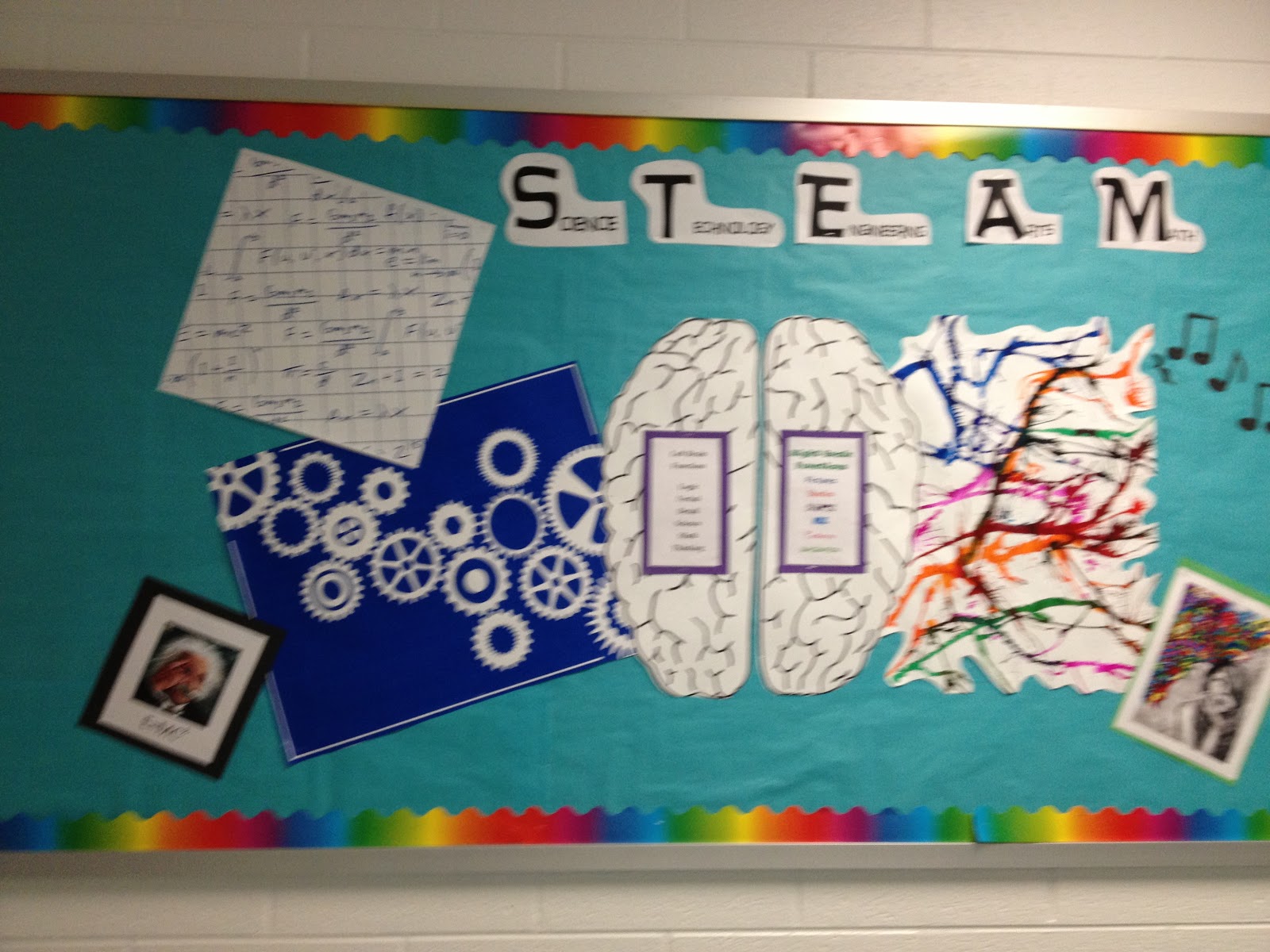
Have you heard about STEAM? Science Technology Engineering Art and Math... Our school is very excited to implement this idea in our classrooms and so we kicked off our year with a STEAM evening for parents and students alike.

First - check out the bullentin board created by my amazing Art and Music teachers at our school.


Students were thrilled to build, build, build...


Future Engineers at play!


Comment:

Tuesday, October 30, 2012

STEM fun on Planet Oobleck

Have you ever heard of the planet Oobleck?  This is one of my favorite lessons from Seeds of Science Planets and Moon unit.

Here is the basic premise - a new planet has been discovered with similar temperature, atmosphere and gravity to the Earth but with a different surface feature.  A satellite has gathered a sample to return to Earth for us to study.  We need to determine what would be the best type of material to use as a lander - cork, plastic cups, spoons, paper clips, Popsicle sticks or straws.

 
Some materials sank and some were able to stay on top without tipping over. After testing each material, we wrote our data down to remember which ones worked the best.  
 
 
After a day of exploring materials we designed a lander that would be able to land on the planet oobleck in our science journals.
 
The next day, I showed up with a ton of materials - plastic cups, tape, straws, paper clips, etc...and we built our own 3-D landers.

 
And no good design experiment would be complete without testing it in the Oobleck as well...


It was lots of fun...and engaging for all students as we explored a "real world" 21st century problem!


Saturday, October 6, 2012

STEM education...and flipping

 I have just returned from a STEM education conference and have become rejuvenated with my thinking about how we approach learning in the classroom.   I have always been an advocate of integrating math and science since my early teaching days....but the implications of technology have always made me a little weary. 

I mean....let's be honest....sometimes I feel like all kids do these days are sit in front of video games.  Why should we continue this at school???

After this conference, my ideas have....FLIPPED.....It's not about mindless video games and instruction...not skill and drill computer games....but instead using technology to enhance our understanding of problem based learning.

I have a million ideas running through my head...but the first BIG idea I walked away with is the idea of "Flipping" our classroom.  Have you heard of this concept? It is not new...but it is not really being used....YET.

This idea is all about introducing content AT HOME through the use of podcasts, screen casts, and/or youtube videos.  Students can sign into a teacher selected site and find the pre-selected video, etc.. for them to watch for homework.  Why?  Well......let's face it....our kids are distracted at school.  At any given time, we truly only have about 60% of attention on our content presentation...I was watching my students just this week as we explored a brainpop video (pretty engaging, right???).  There were a few kids glued to the screen.  But the majority of the class were looking elsewhere ...at their shoes, at the fly in the air, out the window, at their friend, at a scab....you get the picture.

So instead, why not have them watch the same presentation at home where they are NOT distracted by friends, flies, etc..???  Then come in prepared for a discussion and then...more time for application!  That's right...without the 20 minutes of introduction into the content we would be able to get right into experiments, projects, products and hands-on learning.

Educators are always whining about TIME.  This, perhaps, just might give us more....time.

Want to learn more???  So do I!  As I find more information I will continue to blog about resources, ideas and application.